Saturday, June 9, 2012

Is it the reporting about "Everett Ruess: Wilderness Song" -- or the actual documentary -- that are lacking important details?

I recently read one of the only articles I've been able to find about the recent screening of "Everett Ruess: Wilderness Song" in Salt Lake this spring. 


The reporting left me in a quandary because I really felt like the article left out an important point: What is Lindsay Jaeger's documentary actually about and what is it adding to the current discussion about Everett Ruess's enduring mystery and evolving legacy? 


Everett Ruess fans can only gather so much from the Wilderness Song youtube trailer.


As a result, Everett Ruess Disciples like me are largely left to media accounts of Everett's life and influence. However, as a journalist, I am increasingly aware of how news reports that act as the "first rough draft of history" are only as good as an article's credible feedback.


One of the things, I also noticed in this article about Wilderness Song is that the reporter didn't put this movie in context with other Ruess-related media -- including last year's two books about Everett. And more importantly, the reporter should have done enough reporting to know that other documentaries have been made about Everett. 


News is supposed to be new. 


And if Everett Ruess is a Utah icon, as the article's headline suggests, then it should tell people what "new" information is being shown by the creation of this movie. This article only gets to a piece of this and spends almost as much time telling Lindsay Jaeger's story as it does Everett's. It has quotes from people saying the movie followed the right path, but it remains unclear what that path looks like.


Some people will say that that is the point: the article create's buzz about the movie so more people will watch it. That's great, if you have the wherewithal and ability to watch it.


My other concern is that this movie is in its final stages of being done and I haven't heard from Lindsay about my take on her project. According to the Tribune, Jaeger "hopes her documentary will help to keep the interest alive, not just in Ruess as an icon but also as a conduit to a fascination and respect for wilderness lands. Outside of Utah, it’s rare to find people who know who Ruess was. It’s only once they connect his legacy to the larger canvas of environmental concerns that his appeal clicks into view."


Jaeger is a member of my Everett Ruess Disciples group. She knows I'm one the founders -- connecting the Everett Ruess story online. She should also know that I wrote my master's thesis about how the Southern Utah Wilderness Alliance "connect(ed) his legacy" to their environmental concerns. 


So why hasn't she called? I think maybe that's my fault. 


I should have told Jaeger to call me. I guess I just figured anyone who is doing sophisticated research about Everett Ruess would figure out some of her research was already done in 2003.


Philip Fradkin and David Robert's figured this out for their books (even though the fomer left out that fact in his book). Steve Robert's figured it out for his Everett Ruess Arts Festival in Escalante. So why hasn't Jaeger? 


I posed these points on the Everett Ruess Disciples Facebook group and an interesting discussion continues to unfold. 


I'll leave some of my other issues for those postings but I will end by saying that if Jaeger thinks, according to the Tribune article, that very few people know about Everett Ruess she is mistaken. 


I believe the Everett Ruess Disciples, named and unnamed, and the large amount of mass media about Everett Ruess -- including the book "Into the Wild" reaching the New York Times best seller list -- prove otherwise.


---


p.s. One thing that has emerged from the online discussion about this article on Facebook is the news to me that another Everett Ruess movie, "Nemo 1934" is coming out this fall. Information about that project can be viewed here.


One last thought: The Diane Orr said she had tons of footage that didn't make it into her film "Lost Forever." That, to me, is the important stuff Jaeger needs in her movie, along with quotes from the same types of people I interviewed about Everett's connection to the Souther Utah Wilderness Alliance. 


I've got the audio and transcripts, she just needs to add the pictures. Those details found here ...


Friday, May 25, 2012

If I were an artist like Everett Ruess ...

If I was an artist like Everett Ruess I would apply for the Everett Ruess artist in residence (this program) today. I love the Everett Ruess Art Festival and recommend it as one of the best fall travel experiences around.

Side note: School is out for the summer so I get a week off until I start teaching summer school. I will be popping in an out of my Everett Ruess Disciples group on Facebook but, frankly, I'm almost on the verge of leaving Facebook forever. I just don't like trying to maintain friendships on a virtual level.

Thursday, February 23, 2012

The best lessons about Chris McCandless and 'Into the Wild' include Everett Ruess

I've working on a rough outline for an integrated curriculum using the story Everett Ruess as the connecting theme to teach a whole host of subjects. 


In the meantime it'll be interesting to see if this lesson plan about Chris McCandless and Into the Wild generates any interest in my Everett Ruess Disciples group on Facebook. 


Read more: http://www.sfgate.com/cgi-bin/article.cgi?f=/g/a/2012/02/22/prweb9213110.DTL#ixzz1nFw7VD62

Friday, December 23, 2011

Frontier Fellowships at the Epicenter: Would Everett Ruess apply?

As I road the train through the Sierra's today, after a short stop in Green River, Utah, I was reminded of Everett's indomitable spirit. There is a group in Green River who have an interesting mission.

I love that they they offer a "frontier fellowship." Check it out at www.ruralandproud.org.

Screen grab of an endeavor I think Everett would support ... or at least record in his journal or a letter home.

Tuesday, November 1, 2011

Everett Ruess would have hated Mesa Verde today

Everett visited Mesa Verde National Park during an interesting time in history (CCC camps, etc.). My wife actually wrote a book about that time during her time at the park. She wrote about the development of the park and created an archaeologists's bible that helps them preserve some of the modern history as well.


As result, I still have a keen interest in what is going on there and thought I would share a link to some heavy parts of national park management.

If any of you are as interested in enjoying, preserving and protecting our national resources as Everett was, I think you will find this information to be very enlightening. 

http://www.schundler.net/FOIA.htm

Tuesday, September 6, 2011

When I stood ... (continued from Everett's Mesa Verde)

When I stood at the bottom of Square Tower House (called Square House Tower by Everett Ruess) and looked back at the famous overlook, where most people view the site,  I couldn't help but think of Everett Ruess looking down -- feeling inspired to create what I think is one of his best block prints.

Square House Tower and Crow's Nest by Nate Thompson
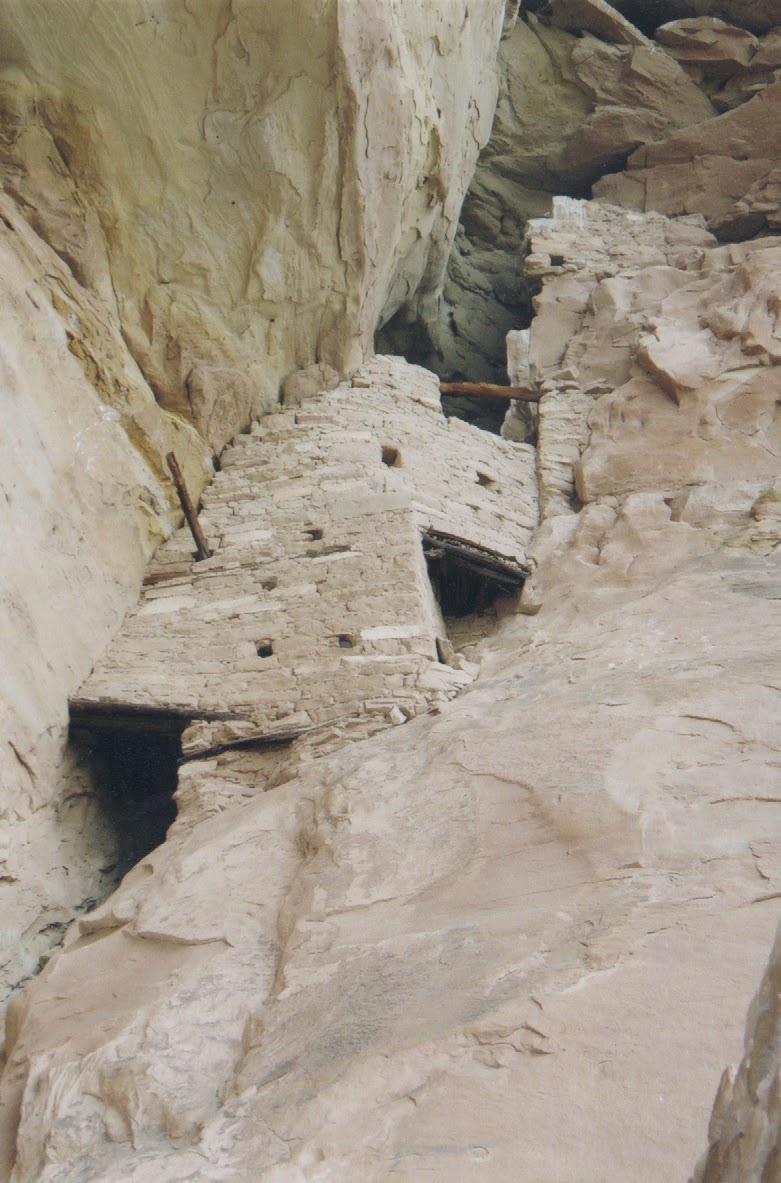
 Square House Tower is the tallest of Mesa Verde National Park's ancient Puebloan (Anasazi) structures and is closed to the public. It is four stories high. Most of the floors are still intact and the walls are painted with bands of bright white and red clay.

I got a chance to see the site first hand in 2003. It was a dream come true because of my love of Everett Ruess country. However, my dream visit evolved when I saw the site's Crow's Nest.

Sitting a dozen yards up and over -- from the front of the site's tower -- the Crow's nest is wedged into a crevasse. It looks as though it will fall at any moment. Surprisingly, the archaeologist who took me to Square Tower said she actually visited the Nest and collected samples of its plastered walls.

The result of my visit that day: I fell in love with ancient Puebloan plaster. It is an integral part of Mesa Verde's "Hidden Landscape" (the unwanted name of my wife's book about Mesa Verde's development as a park). And most visitor's to this an other Puebloan sites don't or can't appreciate it.

The plastered walls Everett may have seen in Mesa Verde are probably long gone. The multi-layered painted surfaces -- some 50 layers thick in some pueblos -- are vanishing during our lifetime.

The Crow's Nest by Nate Thompson
Sometimes my wife jokes like Ronald Reagan and says "if you've seen one Pueblo, you've seen them all." Her response mocks his comment about redwoods. That's when I respond: "What Pueblo?" (Another Reagan joke: He made a similar statement before popping a grape in his mouth after being asked California's famous grape boycott).

What Everett Ruess do people see when they think of Square House Tower or Long House? Are there any journal entries about Everett at Mesa Verde? Surely, a CCC employee would have written something about the novelty of the stranger who stayed in their bunk house?

I proposed offering a special tour called "Everett's Mesa Verde" when I worked as a ranger at the park in 2009. I didn't push the idea very hard because one of my criticism's the books I read about Everett is that, inevitably, the books turn to telling the author's own story.

Friday, August 26, 2011

Mine and Everett's Mesa Verde

Article/issue of the Four Corner's arts perspective 
got me thinking about Cortez. This image hung on my
bedroom wall for years. Great article about the art at 
I once wrote a chapter for a Mesa Verde memory book about Everett Ruess and how his life impacted mine -- by influencing my move to Cortez, Colo.

Today, I had an invite to attend a Mesa Verde Museum Association event and flinched when I couldn't attend: I love Mesa Verde. I love its history. I love that it marks the beginning of my married life.

In short: there is no Ruess media I want to discuss today. I would rather reminisce about Mesa Verde.

I find it a bit ironic that I'm now living in the "land of enchantment." I'm not feeling very enchanted here. Not after living in the shadow of the former capital of the American southwest.

I miss the tourists. I miss the archaeologists. And I actually miss Cortez politics and the weekly onslaught of letters to the editor from the same three cranky Repubs and Demos.

The brand of politics I experience in northern New Mexico is one of hegemonic boredom. There is rarely a letter to an editor -- with any hint of civil discord.

Am I the one who will rock the boat? Not likely. My voice, like Everett's, echoes in the desert with a small hope of someday finding an audience. And for what purpose? To be a famed writer like Wallace Stegner or perhaps a Pulitzer winning reporter? Not likely.

My dreams are sometimes food (to quote the new Cookie Monster). And at the moment, my dreams feel like the time Everett's burrow floundered in the Mancos River.

When I stood ...

(to be continued)


Saturday, August 20, 2011

Ruess-pert weighs in on "Selling Everett Ruess" and "Everett Ruess: His Short Life, Mysterious Death, and Astonishing Afterlife"

When Gary James Bergera used the Everett Ruess quote "the murderous pain of living"as the title for his insightful article into the causes of Everett Ruess' disappearance -- I was disappointed.

It wasn't because I didn't like how Bergera wrote or even what he wrote. It was that he wrote it first.

When I discoverd Bergera's Utah Historical Quarterly article for my master's thesis about Everett, I was still very much a Ruess novice. And in his article, Bergera outlined points about Everett's life that I've been thinking and wanting to articulate for quite some time.

He beat me to the punch and my thesis ended up going in a different direction.

In short, Bergera theorized that Everett was bi-polar and that it led to his mysterious disappearance in the southern Utah wilderness in 1934.

And now Bergera has weighed in on the two most recent books about Everett. His review is a very welcomed point-of-view because he actually knew a little about the Everett Ruess saga before expressing his opinion about David Robert's and Philip Fradkin's new books. Most of the reviews I've read thus far don't offer that kind of credibility.

Wait, did I just say saga? Strange. I rarely, if ever, use that word to describe Everett.

However, as I see the conversations that are expanding on this blog's mirror Facebook group, Everett Ruess Disciples (not the Everett Ruess blockprint group).  I'm beginning to think that the short life and mystery of Everett Ruess is now reaching saga status.

Here is a screen shot one discussion that is expanding the Everett Ruess myth and makes me think the Everett Ruess discussions will never end:


I love that my little Facebook group (195 members encounting!) is enabling the Ruess experts (i.e. Ruess-perts), the Ruess family, and Everett Ruess layman alike -- to discuss someone who has touched the hearts and minds of many people.

There are subtleties to the Disciples discussions most people can't see. Bergera saw them in the new books about Everett Ruess and he pointed it out in his review. I appreciate that.

Writing history can be a sloppy and sometimes political process.

New media (Facebook and this blog included) may muddy the Ruess mystery at first, but I believe it will only help us discover the truth about who Everett is and why the story continues to inspire our investigations as Everett Ruess Disciples.

Sunday, August 7, 2011

The Mystery of Everett Ruess: Repackaged "Vagabond for Beauty" only worth having as a collectable.

I am still working to finish my review of "Selling Everett Ruess" by the end of the week.

If I were a professional freelance journalist it would have been done by now. Fortunately, I am taking care of my two young boys until school starts and then it is off to being a full time middle school science and journalism teacher.

I will say that I am planning to test out some ideas I have for multi-disiplinary school lessons using Ruess as the modus operandi to learning in my honor's science class.

In other news ... 

"Everett Ruess: His short life ..." by Philip Fradkin has just arrived from Amazon.com and I can't wait to review it as soon as possible.

I did a quick perusal of this book's index, but alas my name was not mentioned. I do think some of my research influenced its content so that's not a good first impression (I've always believed you can judge a good book by it's index).

I will say that "Everett Ruess: His short life ... " is being marketed fairly well because the promotions (i.e. press releases?) appear to rely on big name reviewers, Fradkin's past work, and the fact it comes from the University of California Press.

Similar things can be said of "Selling Everett Ruess" by David Roberts.

The marketing of both these books remains my primary interest in Everett so it is interesting to see how these publications are received by the press and public.

Speaking of new books about Everett ...

I finally read W.L. Rusho's afterword to the updating of "Everett Ruess: A Vagabond for Beauty." The book is now titled "The Mystery of Everett Ruess." It has new pictures. A new look coupled with a new beginning and ending.

Rusho's updating to "Vagabond" (found now as POD -- print on demand -- from Gibbs Smith, Publisher) is pretty good, but I don't know that it is worth the money. I like the vagabond title for Rusho's original editing work much better than the updated version -- despite its having a Google friendly title. It is definitely something avid Everett Ruess fans will want on their shelf.

After reading the afterword in "The Mystery of Everett Ruess" I was reminded of my interview with Bud Rusho for my master's thesis research. He had some interesting things to say about David Robert's dealing with Everett Ruess. Much of those sentiments were only alluded to in his afterword to "The Mystery."He told me the same story about digging up the "grave" of Everett that he included in his last book. He showed me pictures of the trip, too.

Rusho mentions my thesis in his afterword to "The Mystery," but does not include its title, author or any other detail. This leaves me to wonder what -- or if -- he thought about my research. I gave Rusho a copy my thesis at an event at the University of Utah when a symposium was held to discuss the initial "solving" of the E.R. mystery in 2009.

The Everett Ruess "cold case" was reinstated a few months after it was solved and Rusho has since passed away.  And I really wish he were still around to offer his critique of the new E.R. books that emerged this summer. I have always appreciated Rusho's matter-of-fact approach to the Everett Ruess story. However, that impression has changed a bit from reading "Finding Everett Ruess" and I will elaborate on that in my forthcoming book review of Robert's book.

One irony I love about Rusho's last book is that the www.gibbs-smith.com site says Rusho "confronts the truth" -- of Robert's reporting about Everett Ruess in National Geographic Adventurer -- "in a new epiloque."

There are truths about the people who are selling the Everett Ruess story for money and political purposes. That story needs to be told to Ruess fans around the world and it isn't being told by Roberts or Rusho. My thesis is too academic for a mass audience. I do get the feeling Fradkin is going to touch on this subject a little bit with his new book but since my name isn't mention I doubt it will included details I think important to the Everett Ruess myth.

And until the references to my thesis stop being too cryptic for a journalist from the Wall Street Journal or L.A. Times to investigate, it seems the truth's I uncovered in my thesis will remain untold to the masses.

So what am I to do? I don't feel like writing letters to the editor. And I want to make my own money "Selling Everett Ruess," too.

I don't need to make a lot of money. I just want to make enough to make it possible for me to be a vagabond like Ruess -- without the poverty of friends, family and money -- as evidence that the same people who read the existing and new Ruess books also get "the rest of the story" (thanks Paul Harvey).

This is hard for me to say. I've never set out to make money off of Everett's story but I've tired of Gibbs Smith flaking on his offers to publish my research. He says he wants to publish it. We have meetings and exchange emails about my book's content. He says that he has read my thesis but I doubt it. My thesis includes some not-so-flattering things about Gibbs Smith and other people with ties to the Southern Utah Wilderness Alliance and those promoting Everett Ruess as a wilderness icon.

Wednesday, July 20, 2011

Did Selling Everett Ruess inspire the title and cover for Finding Everett Ruess?

I find it only a little strange that David Robert's new book has title similar to my working title. Oh, and the cover looks similar to the one I designed.  I can't wait to get my copy of his book to see if he even mentions my research.

For those who have been requesting it ... here is a link to my thesis.